

Summary
In zinc silicate macrocrystalline glazes, nickel oxide is well known for producing blue crystals set on an orange ground. There is a belief circulating in the crystalline glaze community that the blue colour is caused by cobalt contamination of the nickel oxide rather than directly by nickel oxide itself. To test this, I obtained a sample of high purity nickel oxide with a specified maximum cobalt content of <10ppm. I compared the colours from it with regular technical grade nickel oxide and also with a test, free from nickel, but containing a carefully controlled amount of cobalt. The tests showed the characteristic blue in both nickel series and a lack of blue in the cobalt series even though the amount of cobalt exceeded the amount that could have been contributed by the <10ppm present as a contaminent in the high purity nickel oxide sample.
High purity nickel oxide
The nickel oxide was supplied by PI-KEM, the analysis is shown below.

The base glaze
I chose a glaze from my early tests during the year 2002. It containes 3% black nickel oxide as the colourant and is unorthodox in that it contains barium as the only alkaline earth flux. It is realised using my own custom frits, I include the molar analysis to show the oxide content. To establish the correct balance between primary crystal and ground, for each series, I produced a line blend trading Na
Low zinc endmember
Frit ZnNa5515       29.9
Frit ZnNaK5252515   15.7
Barium carbonate     9.1
Grolleg             11.9
Silica              18.2
Zinc oxide          11.3
+Black nickel oxide +3.0
Na2O 0.25 Al2O3 0.10 SiO2 1.90
K2O  0.05
BaO  0.10
ZnO  0.60
High zinc endmember
Frit ZnNa5515       29.9
Frit ZnNaK5252515   15.7
Barium carbonate     9.1
Grolleg             11.9
Silica              18.2
Zinc oxide          11.3
+Black nickel oxide +3.0
Na2O 0.15  Al2O3 0.10  SiO2 1.90
K2O  0.05
BaO  0.10
ZnO  0.70
A controlled cobalt source
The glaze with 3% high purity nickel oxide contains at most 0.3ppm by mass of cobalt, expressed as the element. It is well beyond the capability of my weighing equipment to add that sort of level directly. Instead, I added 1g of cobalt oxide, as Co
Mixing, glazing and firing
For each of the 6 test glazes, I prepared a 50g batch and mixed it in a ball mill with 16g of water. The mill time was 1 hour in each case. For each series, I covered 8 test faces with a glaze loading of 1200g/m
Results
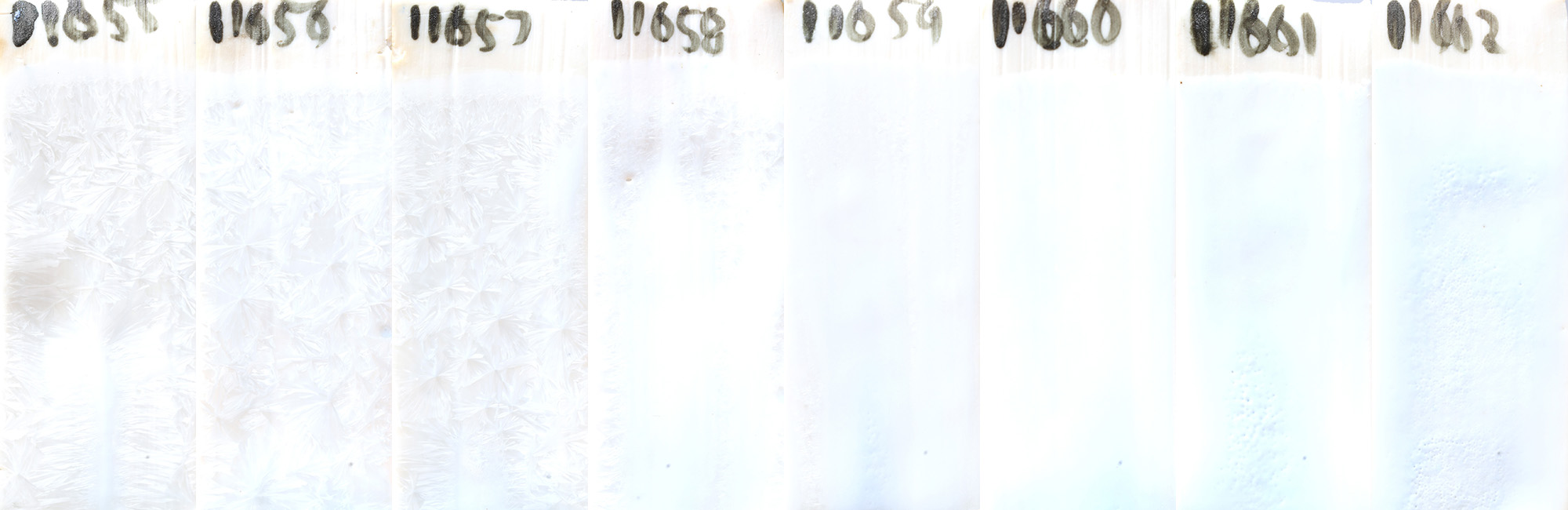
High purity nickel oxide series

Technical grade nickel oxide series

Cobalt only series
Discussion
Setting aside the differences in crystal nucleation, the series with nickel oxide show little, if any, difference in colour: the crystals are blue and the ground, though partially obscured by prolific secondary crystallisation, is orange/yellow. The tests without nickel, containing 735ppm of cobalt, show only the faintest blue and that shows most strongly in the crystals rather than the glassy ground. The conclusion is that nickel alone is responsible for the blue of the primary crystals. That cobalt produces a detectable colour at only 735ppm shows just how powerful a colurant it is. It certainly seems plausible that cobalt contamination of nickel oxide at the percentage level would influence the overall colour, but the assertion that cobalt contamination is solely responsible for the blue colour is not sustained by these results.
Other colours from Nickel
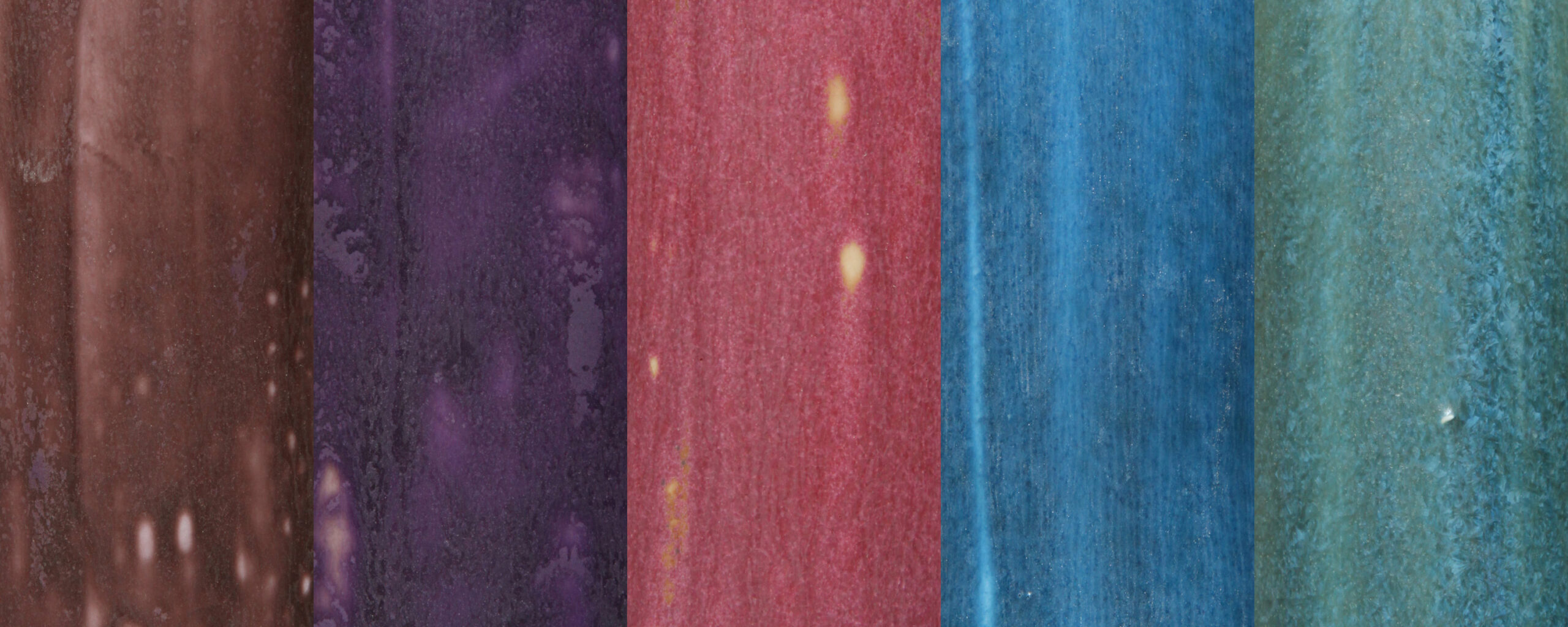
Nickel offers a wide range of colours depending on the glaze chemistry. The colour produced by nickel, and other colourants, also depends on whether the glaze remains glassy or forms crystalline phases. In the glassy phase, nickel is present as the Ni
In crystalline phases the colours are different. The blue colour demonstarted here is caused by Ni
High barium endmember
FFF feldspar         6.5
3110 frit           12.4
Barium carbonate    51.0
Grolleg             17.9
Silica               9.9
Zinc oxide           2.2
+Black nickel oxide +1.5
NaKO 0.15  Al2O3 0.250 SiO2 1.50
CaO  0.04  B2O3  0.015
BaO  0.75
ZnO  0.08
High zinc endmember
FFF feldspar         8.6
3110 frit           16.5
Barium carbonate    11.8
Grolleg             23.9
Silica              13.1
Zinc oxide          26.1
+Black nickel oxide +1.5
NaKO 0.15  Al2O3 0.250 SiO2 1.50
CaO  0.04  B2O3  0.015
BaO  0.13
ZnO  0.70
Nickel containing frits
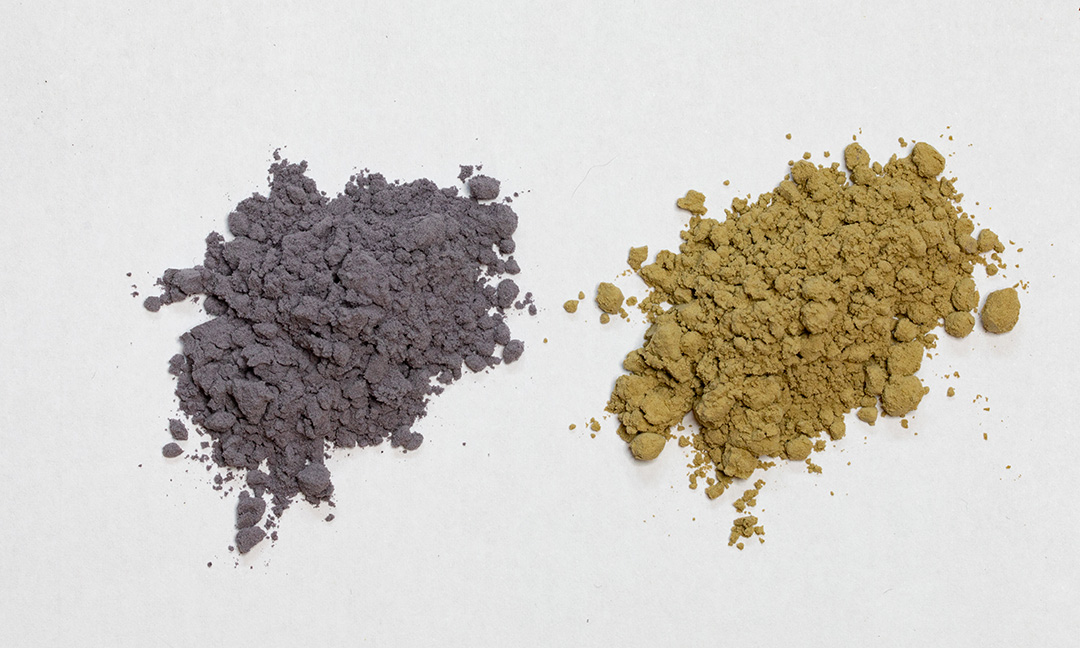
To support my research into nickel colours, I have produced a series of frits. These are necessary to introduce high levels of sodium and potassium using insoluble sources that are otherwise unavailable. The frits provide suffificent monovalent compensating cations to charge compensate the nickel allowing it to participate as a glass former in the tetrahedral silica network. To give low solubility the frits also incorporate divalent cations form the alkaline earth series: barium for the lower field strength and calcium or magnesium for the higher field strength. The raw materials for the frit are fully melted at 1200°C an form a black glass that not even a powerful loight source can reveil any colour in. It is only after grinding to a fine powder that the colour is revealed: purple for the K/Ba low field strength and brown for the Na/Ca intermediate field strength. Placing the NiO in the second column recognises that, like alumina, it participates as a glass former when charge balanced. I found that 0.3 mols of NiO (base unity) is close to the limit of incorporation under these conditions. With 0.4 mols and above, instead of a unifom glass, there are two layers: the black glass and a green layer of nickel (II) oxide.
Low field strength nickel frit
K2O 0.7  NiO 0.3  SiO2 2.4
BaO 0.3
Higher field strength nickel frit
Na2O 0.7  NiO 0.3  SiO2 2.4
CaO  0.3
Two of my nickel frits, left with potassium and barium, right with sodium and calcium.
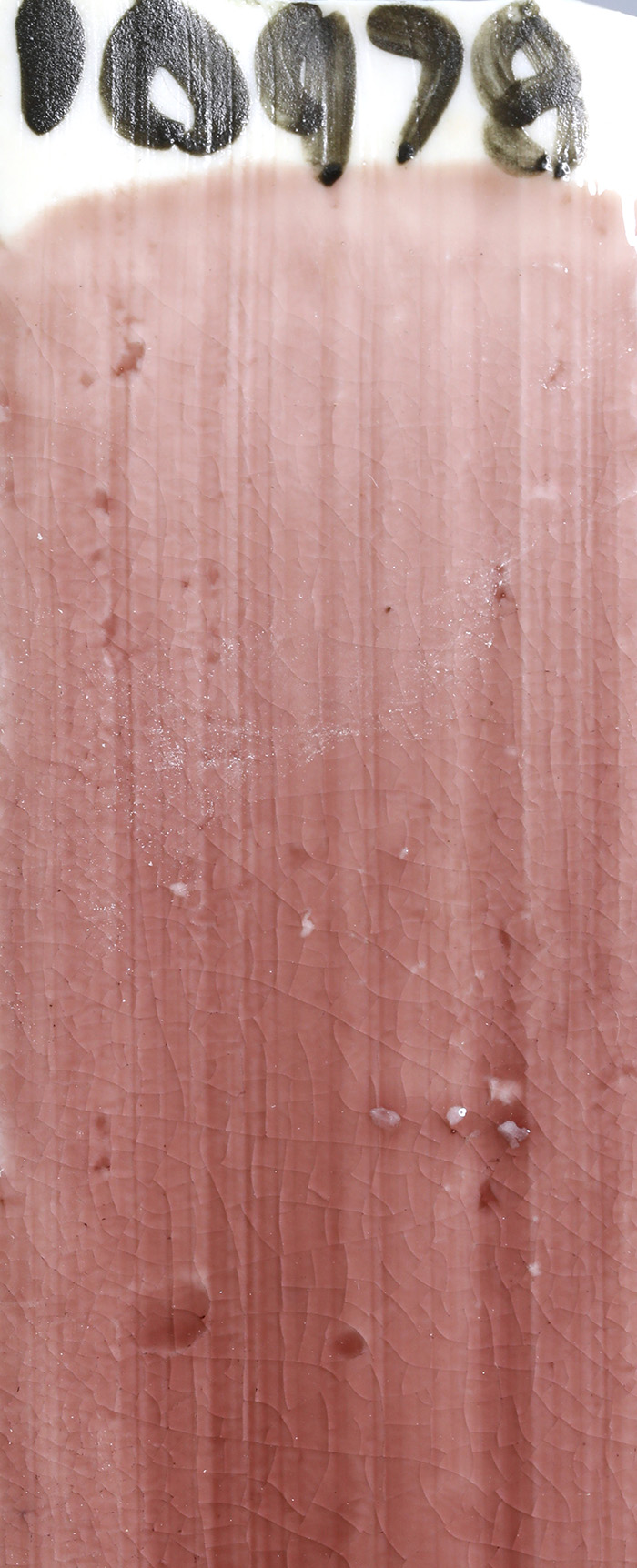
Glaze 10978
Frit 9952KBa        80.2
Barium carbonate     1.1
Grolleg              5.1
Silica               5.1
Zinc oxide           6.5
Black nickel oxide   2.0
K2O 0.55 Al2O3 0.05  SiO2 2.2
BaO 0.25 NiO   0.06
ZnO 0.20
References
[1] W.A. Weyl; ‘Coloured Glasses’; Society of Glass Technology; p199.
[2] Emmanuel Cooper; ‘The Complete Potter: Glazes’; B. T. Batsford; p84.